October is one of the most important months in a third grade math year. Students are moving from addition-based thinking into multiplication, which is one of the biggest conceptual jumps in elementary math. At the same time, they are working with three-digit numbers, rounding, and regrouping. It is a lot of new content arriving at once, and it all needs practice.
October also brings Halloween, and with it a classroom full of excited, distracted eight-year-olds. The good news is that you can use that energy instead of fighting it. This guide explains how to teach and practice the key third grade skills of the fall, why self-checking color-by-number activities are so effective for this age, and how to plan a calm, productive Halloween month that still feels like a celebration.
The Big Skills of Fall in Third Grade
Before choosing activities, it helps to know exactly what students need to master. In most third grade curricula, the fall focuses on these areas.
Understanding multiplication
Students learn that multiplication means equal groups. Three bags with four candies each is 3 × 4. They represent this with arrays, equal-group drawings and repeated addition before they move toward memorized facts.
Multiplication facts
By the end of third grade, students are expected to multiply fluently within 100. That means knowing their facts, not counting on fingers. Most teachers start with the easier facts (2s, 5s and 10s), then 3s and 4s, and finally the trickier 6s, 7s, 8s and 9s.
Rounding
Third graders learn to round whole numbers to the nearest 10 or 100. This is the foundation for estimation and for checking whether an answer is reasonable.
Adding and subtracting within 1,000
Students add and subtract three-digit numbers, including regrouping (carrying and borrowing). This builds directly on second grade work but with bigger numbers and more steps.
These skills line up with common third grade standards for operations and algebraic thinking (multiplying within 100) and number and operations in base ten (rounding, and adding and subtracting within 1,000).
Why Self-Checking Activities Matter at This Age
Third graders are capable of a lot of independent work, but they often do not know when they have made a mistake. A worksheet of 20 multiplication problems can come back with 8 errors, and the student had no idea. By the time you grade it, the moment for learning has passed.
Self-checking activities change that. In a color-by-number mystery picture, each answer is a number on a grid. Students solve a problem, find the answer on the grid, and color it. If their answer is not on the grid, they know right away that something is wrong. If they color the wrong square, the picture looks off. Either way, the feedback is immediate.
That instant feedback does three valuable things:
- It catches errors while the student still remembers how they solved the problem.
- It builds the habit of checking work, which is one of the most important math habits a student can develop.
- It reduces the amount of grading you need to do, because the finished picture tells you most of what you need to know.
Teaching Multiplication with Arrays
Arrays are one of the most powerful tools for building multiplication understanding. An array is a set of objects arranged in equal rows and columns. Three rows of five dots is a picture of 3 × 5.
Why arrays work
Arrays make multiplication visible. Students can see that 3 × 5 and 5 × 3 have the same total (the commutative property) by turning the array sideways. They can see that 6 × 4 is the same as two arrays of 3 × 4 (an early taste of the distributive property). Arrays also connect directly to area, which students study later in the year.
A simple array lesson
- Give each student a handful of small counters (or candy corn shapes, if you want to lean into the season).
- Ask them to make 3 rows of 4.
- Ask: "How many in each row? How many rows? How many in all?"
- Write the equation together: 3 × 4 = 12.
- Turn the array sideways and ask what equation it shows now.
After a few days of building arrays, students are ready to look at a drawn array and write the equation themselves. That is exactly the first skill practiced in the 3rd Grade Halloween Math Mystery Pictures, where students look at arrays and write the matching multiplication equation, then find the product on the grid.
Skip Counting: The Bridge to Multiplication Facts
Skip counting by 2s, 5s and 10s is something students start in first and second grade. In third grade, it becomes a strategy for multiplication. If a student knows 5, 10, 15, 20, 25, they can find 5 × 5 by counting five jumps.
Extend skip counting to 3s and 4s. Practice it in fun ways:
- Count by 3s while doing a movement, such as a clap on every number.
- Fill in missing numbers in a skip counting sequence: 4, 8, ___, 16, ___, 24.
- Hang a number line and have students hop along it.
Missing-number skip counting problems are a great warm-up because they require students to understand the pattern, not just recite it.
Word Problems: Making Multiplication Meaningful
Many students can recite 4 × 5 = 20 but cannot tell you when to use multiplication in a real situation. Word problems build that understanding.
Use simple, seasonal contexts:
- "There are 5 pumpkins in each row. There are 4 rows. How many pumpkins are there?"
- "Each bag holds 3 candies. You have 10 bags. How many candies in all?"
- "A spider has 8 legs. How many legs do 2 spiders have?"
A routine for solving word problems
Teach a simple routine and use it consistently:
- Read the problem twice.
- Picture it: draw groups or an array.
- Decide: are we putting equal groups together? Then multiply.
- Solve and write the equation.
- Check: does the answer make sense?
The word problems in the 3rd grade Halloween set use facts of 2, 3, 4, 5 and 10, which keeps the arithmetic manageable so students can focus on understanding the situation.
Mastering the Harder Facts: 6, 7, 8 and 9
The facts for 6, 7, 8 and 9 are where many third graders get stuck. These facts are harder to skip count and harder to visualize. A few strategies help a lot.
Use known facts to find unknown facts
- 6s: Double the 3s. If 3 × 7 = 21, then 6 × 7 = 42.
- 8s: Double the 4s. If 4 × 6 = 24, then 8 × 6 = 48.
- 9s: Use 10s and subtract. 9 × 7 is 10 × 7 minus 7, which is 70 − 7 = 63.
- 7s: Break them apart. 7 × 8 is 5 × 8 plus 2 × 8, which is 40 + 16 = 56.
Practice in short, frequent bursts
Five minutes a day of fact practice is far more effective than one long session a week. Use quick games, partner flash cards or a mystery picture page that focuses on a set of facts.
Celebrate progress
Have students track which facts they know. A simple chart where they color in mastered facts gives them a visible goal and a sense of accomplishment.
Teaching Rounding So It Makes Sense
Rounding often gets taught as a rule: "five or more, round up." Students can follow the rule, but many do not understand why it works, and they make errors with numbers like 95 or 350.
Start with a number line
Draw a number line from 30 to 40. Place 34 on it. Ask: "Is 34 closer to 30 or 40?" Students can see it is closer to 30. Then place 37. It is closer to 40. Then place 35. It is exactly in the middle, and we agree to round up.
Use the "hill" picture
Some teachers draw a hill with the tens on either side of the bottom and the five at the top. Numbers 1 to 4 roll back down to the lower ten. Numbers 5 to 9 roll over the top to the higher ten. Students remember this image well.
Move to hundreds
Once students are confident with tens, use the same number line approach for hundreds. Is 342 closer to 300 or 400? Is 350? Is 389?
Practice with real estimation
Rounding has a purpose. Show students how to estimate a sum: 289 + 412 is about 300 + 400, so the answer should be about 700. If they get 1,701, they know something went wrong. This is where rounding becomes a powerful checking tool, not just an isolated skill.
The 3rd grade Halloween set includes separate pictures for rounding to the nearest ten and rounding to the nearest hundred, so you can practice each step on its own before mixing them.
Adding and Subtracting Within 1,000 with Regrouping
Three-digit addition and subtraction with regrouping is a skill that needs both understanding and practice.
Build understanding with base-ten blocks
Before students use the standard method, have them model problems with base-ten blocks. When they add 268 + 157, they combine ones and see they have 15 ones, which they trade for 1 ten and 5 ones. That physical trade is what "carrying" actually means.
Watch for common errors
- Not lining up places. Students write 268 + 57 with the 5 under the 2. Graph paper or place value columns help.
- Forgetting to add the regrouped ten. Encourage students to write the small 1 clearly at the top of the next column.
- Subtracting the smaller digit from the larger. In 452 − 178, a student may write 8 − 2 = 6 in the ones place instead of regrouping. This is one of the most common subtraction errors, and it is worth naming directly with your class.
- Zeros in the middle. Problems like 503 − 268 require regrouping across a zero, which confuses many students. Give these problems extra attention.
Estimate first
Before solving, have students estimate. If 452 − 178 is about 450 − 180, which is about 270, then an answer of 326 should raise a flag.
How to Run a Color-by-Number Math Day
Here is a practical routine for using a mystery picture set across a week.
Day 1: Solve
Students complete the problem page. They solve each problem and write the answer next to it. Encourage them to show their work.
Day 2: Color
Students use their answers to color the grid. As they find each answer, they color the matching squares. If an answer is not on the grid, they go back and rework the problem.
Friday: Fix-it day
Students who have errors or missing answers fix them. Students who finished correctly can help a partner or move on to an extension. This "Fix-it Friday" idea, built into the 4-week study plan included in the set, gives every student a chance to correct mistakes before moving on.
Why split solving and coloring?
Splitting the work across two days does a few things. It keeps each session focused. It gives you a chance to look over the problem pages before coloring begins. And it gives students something to look forward to, because the picture reveal comes on day two.
A 4-Week October Plan for Third Grade
Here is one way to organize a month of Halloween math using eight mystery pictures.
Week 1: Understanding multiplication
- Mon/Tue: Arrays, write the multiplication equation.
- Wed/Thu: Skip counting, find the missing number.
- Fri: Fix-it day and array games.
Week 2: Multiplication in context and harder facts
- Mon/Tue: Multiplication word problems with facts of 2, 3, 4, 5 and 10.
- Wed/Thu: Facts of 6, 7, 8 and 9.
- Fri: Fix-it day and fact fluency games.
Week 3: Rounding
- Mon/Tue: Rounding to the nearest ten.
- Wed/Thu: Rounding to the nearest hundred.
- Fri: Fix-it day and estimation challenges.
Week 4: Adding and subtracting within 1,000
- Mon/Tue: Adding with regrouping.
- Wed/Thu: Subtracting with regrouping.
- Fri: Fix-it day and Halloween celebration.
This plan gives you two days per skill, which is enough for practice without dragging, and a weekly checkpoint to catch misunderstandings.
Differentiation Tips
Every third grade class has a wide range. Here are ways to support everyone.
For students who need more support
- Provide a multiplication chart for the first picture, then remove it.
- Let them use base-ten blocks or a number line.
- Have them solve only the first half of the problems, check with you, then continue.
- Pair them with a supportive partner for the coloring step.
For students who need more challenge
- Ask them to write their own word problem for a classmate.
- Have them explain the strategy they used for a hard fact.
- Give them a mixed review page that combines skills.
- Let them create a "teacher answer key" by checking a classmate's work.
Keeping Halloween Calm and Productive
Halloween excitement is real. A few classroom management ideas help.
- Keep routines consistent. Students feel safer when the day follows the familiar structure, even with a seasonal theme.
- Use the theme as a reward. "When we finish our problems, we get to reveal the Halloween picture."
- Plan quieter activities for the afternoon. Coloring is calming, which makes mystery pictures a great after-lunch activity.
- Keep it friendly. Not all families celebrate Halloween in the same way. Friendly images like pumpkins, bats and candy corn are widely comfortable, and nothing needs to be scary.
Using the Results to Guide Instruction
A finished mystery picture is a quick formative assessment.
- Picture correct, all problems right: the student is ready to move on.
- A few wrong squares: look at which problems were missed. Often it is one type of error, such as regrouping across zero.
- Many wrong squares: the student needs reteaching, probably in a small group.
Keep a simple checklist of skills and mark each student's result. By the end of October you will have a clear picture of who has mastered each fall skill and who needs more support before you move on.
Frequently Asked Questions
Can students guess the picture without solving the problems?
In a well-designed mystery picture, no. The squares are only colored when the answers are correct, so students cannot fill in the picture by guessing the shape.
Is color by number too easy for third grade?
Not when the problems are real third grade math. The coloring is the reward, but the work is solving multiplication, rounding and regrouping problems.
How long does each picture take?
Most students solve the problems in one 30 to 40 minute session and color in another session of similar length.
What supplies do I need?
Just the printed pages, pencils and colored pencils or crayons. The pages are black and white, so any printer works.
Can I use these for sub plans?
Yes. The routine is easy for a substitute to explain, and students can work independently.
Bringing It Together
October in third grade is a busy, important month. Students are building multiplication understanding, learning hard facts, rounding and working with three-digit numbers. Self-checking color-by-number activities give them the practice they need while catching mistakes in the moment, and the Halloween theme turns a month of review into something students look forward to.
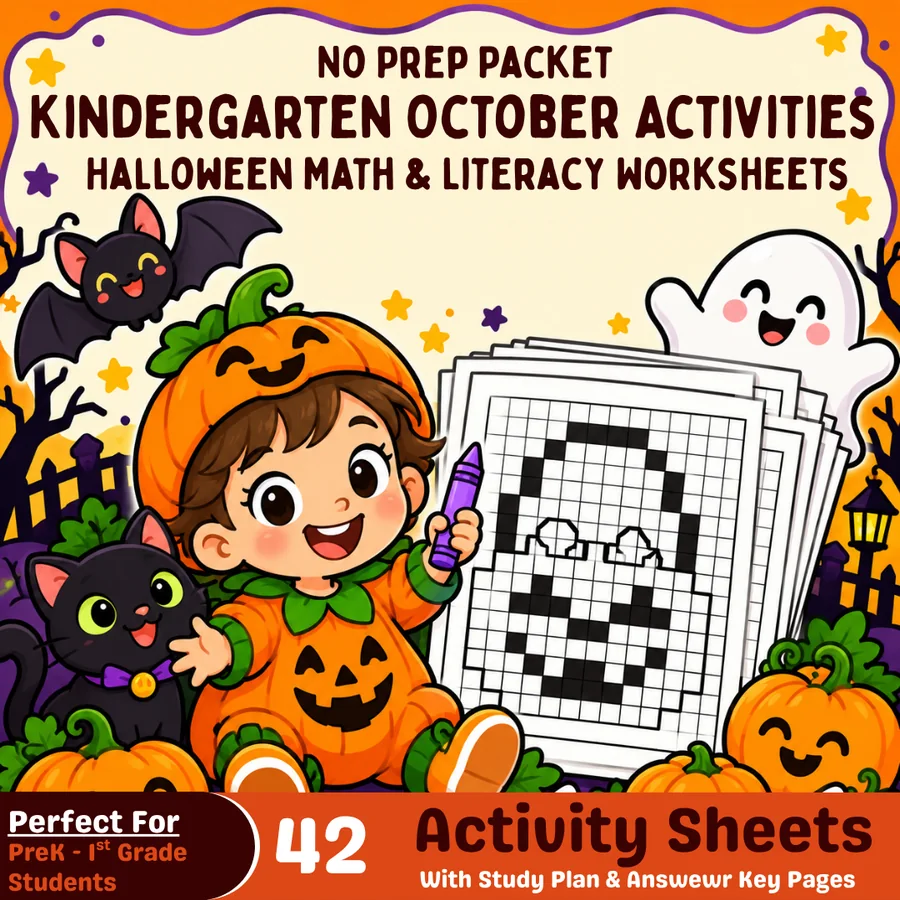
The 3rd Grade Halloween Math Mystery Pictures gives you eight original pictures, each tied to one of the skills in this guide, plus a 4-week study plan, a How to Use page, color answer keys and a Math Mystery Solver certificate. Print it once and October math is planned.