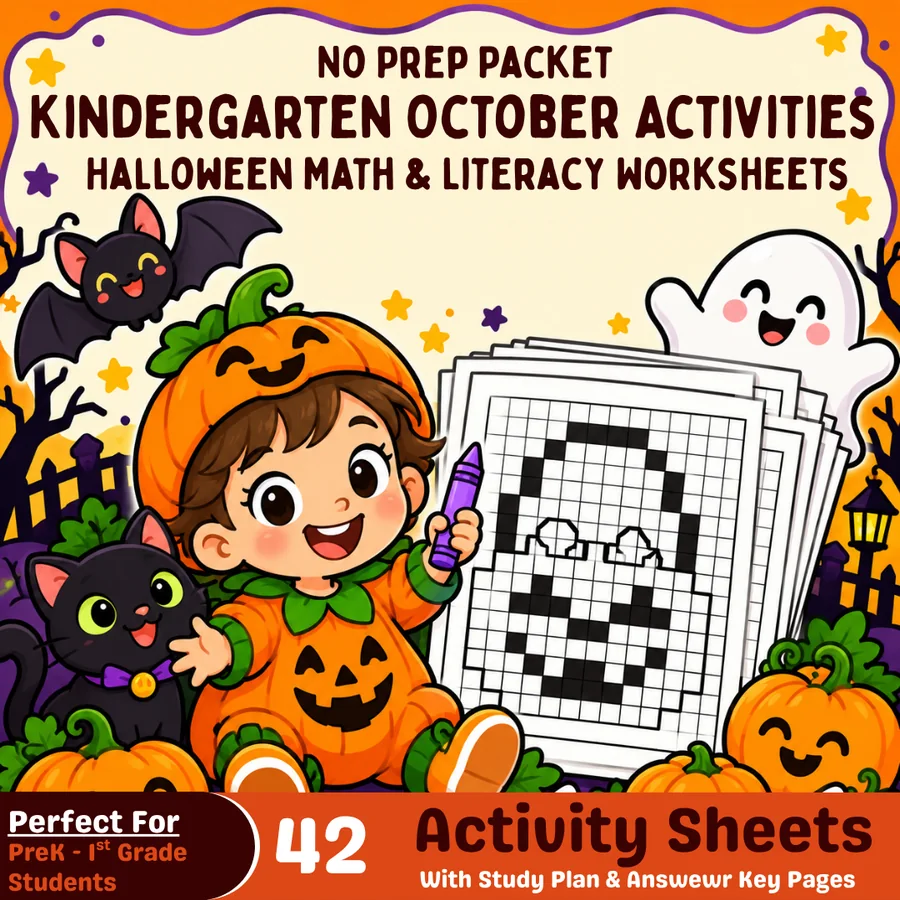
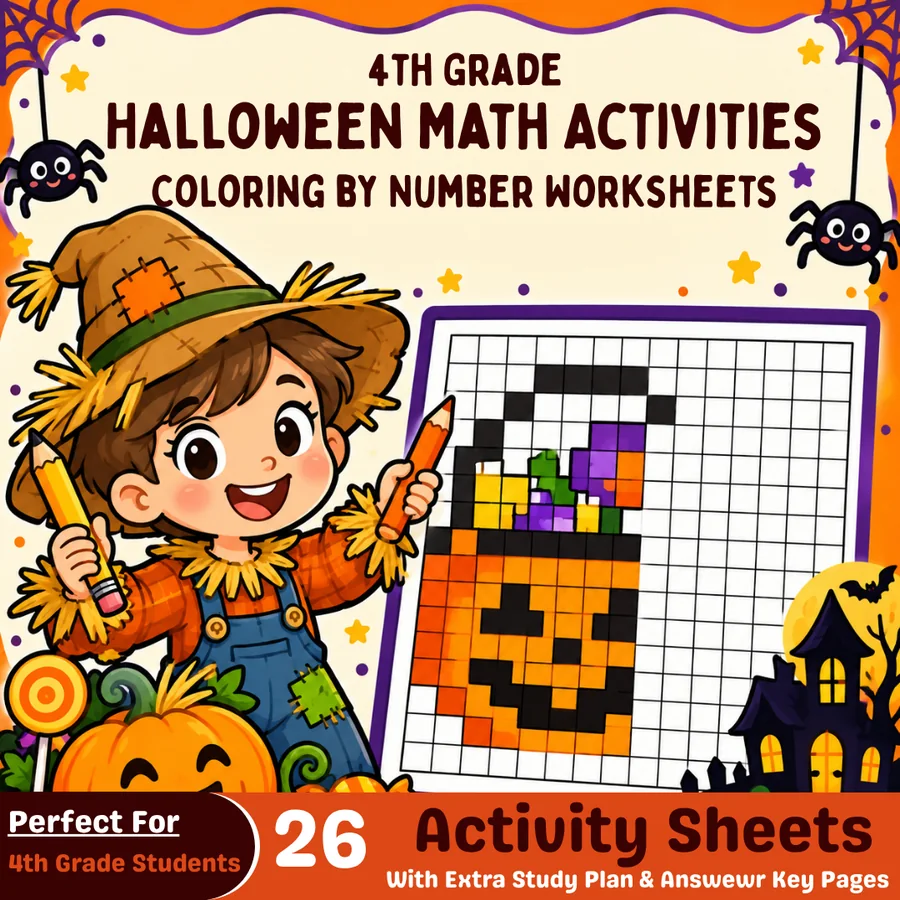
October in a preschool classroom is full of wonder. Leaves change color and fall from the trees. Pumpkins appear at the grocery store. Apples are in season, acorns cover the playground, and the air feels different. Young children notice all of it, and that natural curiosity makes the harvest season one of the best themes of the year.
A fall harvest theme gives you a simple, consistent context for teaching early math, literacy, fine motor and thinking skills. This guide explains what preschoolers are ready to learn in October, how to teach each skill in a developmentally appropriate way, and how to put it all together into a four-week harvest plan with short printable activities and plenty of hands-on play.
What Preschoolers Are Ready to Learn in October
Preschool children vary enormously in their development, especially early in the school year. Some three-year-olds are still learning to hold a crayon, while some older four-year-olds can write their name. A good October plan meets children where they are and offers short, achievable activities.
Most preschool, Pre-K and TK children in the fall are working on:
Early math
- Counting objects with one-to-one correspondence.
- Recognizing numerals, often 1 to 10.
- Understanding that a number represents a quantity.
- Using ten frames to see quantities.
- Noticing and continuing simple patterns.
- Recognizing basic shapes such as circles and triangles.
Early literacy
- Recognizing letters, especially those in their name.
- Learning letter sounds, starting with first sounds in words.
- Tracing and beginning to write letters.
- Recognizing a few simple words like is and the.
- Understanding that print carries meaning.
Fine motor
- Holding a pencil or crayon with control.
- Tracing lines and paths.
- Using scissors to cut along lines.
- Coloring within a space.
Thinking skills
- Matching and sorting.
- Noticing similarities and differences.
- Completing simple puzzles.
Why a Harvest Theme Works So Well
Themes help young children make connections. When the counting activity, the letter page, the story and the sensory bin all feature pumpkins and apples, children build vocabulary and understanding that reinforces itself.
A harvest theme has a few special advantages:
- It is real. Children can see, touch and smell pumpkins, apples and leaves.
- It is inclusive. Harvest is celebrated across many cultures and does not depend on any particular holiday.
- It is rich in vocabulary. Words like harvest, orchard, acorn, vine, scarecrow and wheelbarrow expand children's language.
- It connects to science. Children can observe how pumpkins grow, why leaves change color and how animals prepare for winter.
Teaching Numbers 6 to 10
Many preschool programs introduce numbers 1 to 5 in the first weeks of school and move to 6 to 10 in October. These larger numbers are harder because children can no longer recognize the quantity at a glance. They need to count carefully.
Teach one number at a time
Give each number its own focus, perhaps one or two days. For each number, children should:
- See the numeral and trace it.
- See the number word and trace it.
- Count a matching set of objects.
- Show the number on a ten frame.
This four-part approach connects the symbol, the word and the quantity, which is the heart of number sense.
Use ten frames
Ten frames are rows of five boxes. When children fill a ten frame, they start to see numbers in relation to five and ten. Seven is "five and two more." Nine is "one less than ten." This structure becomes the foundation for addition and place value later.
Make counting physical
Count everything: apples in a basket, children in the line, jumps on the playground. When children touch each object as they count, they build one-to-one correspondence.
The Preschool October Harvest Packet includes a page for each number from 6 to 10 that follows exactly this structure: trace the numeral, trace the word, color that many pictures and color a ten frame.
Review numbers 1 to 5
Even as you introduce larger numbers, keep reviewing 1 to 5. A quick review page or a game of "show me three fingers" keeps earlier learning fresh.
One-to-one correspondence
A "one leaf for each tree" activity, where children cut out leaves and glue one beside each tree, is a playful way to practice matching one object to one place. This is an important skill that underlies all counting.
Teaching Letters E, F, G and H
Many preschool programs introduce a few letters at a time. In October, letters like E, F, G and H fit naturally after A to D.
Tracing and writing
Each letter should be practiced in both uppercase and lowercase. Start with large movements: skywriting with a finger, tracing in sand, forming the letter with play dough. Then move to tracing on paper and finally writing with a pencil.
Dot paths
A dot path page, where children trace a path of dots in the shape of a letter, builds both letter formation and fine motor control.
Letter sounds
Connect each letter to its sound and to a familiar word with a picture. E might go with egg, F with fox or fall, G with goat or gourd, and H with hat or hay. Harvest words make strong connections.
First sounds A to H
Once children know several letters, play first-sound games. Show a picture and ask, "What sound does this start with?" Then have children find the matching letter.
Early Reading in Preschool
Many preschoolers are ready to recognize a few simple, very common words. Is and the are good starting words because they appear in almost every simple sentence.
Cut and paste sight word activities
Children cut out a word and glue it into a sentence or match it to the same word. This combines reading, cutting and gluing.
Simple sentences
Simple "I Can Read!" sentences such as "The apple is red." give children an early taste of reading on their own. Read the sentence together, point to each word, and celebrate.
It is important to keep these activities light and positive at this age. The goal is exposure and confidence, not pressure.
Shapes in the Harvest Season
Triangles are a great shape to focus on in October, because they show up in pumpkin faces, scarecrow hats and slices of pie.
- Triangle hunt: children find and color all the triangles in a picture.
- Shape paths: children trace a path along triangles and circles, building fine motor control.
- Shape art: children make a scarecrow or pumpkin from paper shapes.
Fine Motor Skills: The Foundation for Writing
Fine motor skills are the small muscle movements of the hands and fingers. They are essential for writing, cutting, buttoning and many other everyday tasks. Preschoolers need lots of practice.
Tracing paths
A "path to the pumpkin" page, where children trace a line from a character to a pumpkin, builds pencil control and left-to-right movement.
Cutting practice
Cutting is hard for young children. Start with straight lines, then curves and zigzags. Teach the "thumbs up" position: the thumb on top of the scissors, pointing to the ceiling.
Coloring
Coloring within a shape builds control and patience. Encourage children to color slowly and stay inside the lines, but praise effort above all.
Hands-on fine motor activities
- Use tongs to move acorns from one bowl to another.
- Tear paper leaves for a collage.
- Squeeze play dough into pumpkin shapes.
- Lace yarn through holes in a paper apple.
Thinking and Art Activities
Thinking skills grow through puzzles and observation.
- Color words: coloring apples according to a color word introduces simple reading.
- Color by dots and color by number: these activities build number recognition and following directions. A scarecrow color by number is a seasonal favorite.
- A to Z dot-to-dot: connecting letters in order to reveal a pumpkin practices the alphabet sequence.
- Patterns: cut-and-paste leaf patterns build early algebraic thinking.
- Match the other half: completing a symmetrical picture builds spatial reasoning.
- Which one is different? finding the odd one out builds visual discrimination.
Seasonal Learning: Clothing, Color and Safety
What do we wear in fall?
Talking about fall clothing like sweaters, scarves and boots connects learning to children's daily lives and builds vocabulary.
The color orange
A whole page about the color orange, with pumpkins, carrots and leaves, is a playful way to celebrate the season.
Fire safety
October is Fire Prevention Month in the United States, and many preschools focus on fire safety in early October. Teach the simple "stop, drop and roll" routine and practice it physically. Keep the tone calm and reassuring. Many fire departments also offer school visits.
A Four-Week Harvest Plan
Here is one way to organize October using one or two short printable activities a day, following the rhythm of the 4-week study plan included in the Preschool October Harvest Packet. Pair each day's pages with hands-on play.
Week 1: Apples and number 6
- Monday: Number 6 page and path to the pumpkin tracing.
- Tuesday: Letter E trace and write, apple counting with real apples.
- Wednesday: Numbers 1 to 5 review and cutting practice.
- Thursday: Dot the letter path for E and color word apples.
- Friday: Fire safety page, then practice stop, drop and roll.
Week 2: Pumpkins and numbers 7 and 8
- Monday: Number 7 page and triangle hunt.
- Tuesday: Letter F trace and write, pumpkin sensory bin.
- Wednesday: Number 8 page and leaf patterns.
- Thursday: Dot the letter path for F and the color orange.
- Friday: Count and dot, then pumpkin painting.
Week 3: Leaves and number 9
- Monday: Number 9 page and triangle and circle paths.
- Tuesday: Letter G trace and write, leaf rubbings.
- Wednesday: One leaf for each tree and match the other half.
- Thursday: Dot the letter path for G and "is" sight word cut and paste.
- Friday: What do we wear in fall? and dress-up play.
Week 4: Harvest celebration and number 10
- Monday: Number 10 page and color by number scarecrow.
- Tuesday: Letter H trace and write, "the" sight word cut and paste.
- Wednesday: First sounds A to H and which one is different?
- Thursday: I Can Read! sentences and A to Z pumpkin dot-to-dot.
- Friday: Harvest celebration and Harvest Helper certificates.
Hands-On Harvest Activities
Printables are most effective when paired with real experiences. Try these throughout the month.
- Apple tasting: compare red, green and yellow apples and make a class graph of favorites.
- Pumpkin investigation: measure a pumpkin with string, count its lines and guess how many seeds are inside.
- Leaf sorting: sort collected leaves by color, size or shape.
- Acorn counting: count acorns into ten frames.
- Harvest dramatic play: set up a farm stand with play food, baskets and a cash register.
- Scarecrow building: stuff old clothes with newspaper to make a class scarecrow.
- Seed planting: plant pumpkin seeds in cups and watch them sprout.
Setting Up a Harvest Classroom
The environment is a powerful teacher in preschool. A few simple changes make the harvest theme feel alive.
- Discovery table. Fill a low table with real pumpkins, gourds, apples, pinecones, acorns and dried corn, plus magnifying glasses and a balance scale.
- Sensory bin. Fill a bin with dried corn kernels, mini pumpkins, scoops and cups. Add numeral cards so children can count scoops into cups.
- Writing center. Offer harvest word cards with pictures, trays of salt or sand for finger-tracing letters, and clipboards with tracing pages.
- Math center. Set out ten frames, acorn counters and number cards from 1 to 10.
- Book corner. Display fiction and nonfiction books about apples, pumpkins, farms, leaves and animals getting ready for winter.
- Art easel. Provide orange, red, yellow and brown paint for fall paintings.
Rotate materials each week to match the focus number and letter, and children will keep returning to explore.
Circle Time Ideas for the Harvest Season
Circle time is a chance to introduce each day's focus with songs, stories and movement.
- Counting songs. Sing about apples falling from a tree or pumpkins sitting on a fence, removing one each verse. These songs naturally practice counting down.
- Letter of the week bag. Fill a bag with objects that start with the week's letter. Pull them out one at a time and say the first sound together.
- Harvest show and tell. Invite children to bring something from fall: a leaf, a pinecone, a photo from a farm visit.
- Movement breaks. Pretend to be leaves blowing in the wind, scarecrows standing still or squirrels gathering acorns.
Five to ten minutes of circle time sets up the day's printable activity so children already understand the idea before they pick up a crayon.
Keeping Activities Developmentally Appropriate
Preschoolers learn best through play, movement and conversation. Printable activities should be short and positive.
- Keep pages short. One skill per page, five to ten minutes.
- Do not force it. If a child is frustrated, try again later or use a hands-on version.
- Praise effort. "You worked so hard on that 8!"
- Talk while they work. Ask questions and model vocabulary.
- Expect wide variation. Some children will trace perfectly; others will scribble. Both are normal.
Supporting Every Learner
For children who need support
- Use hand-over-hand guidance for tracing.
- Offer chunky crayons and adapted scissors.
- Focus on numbers 1 to 5 before moving to larger numbers.
- Use real objects alongside every page.
For children ready for more
- Have them write the numbers without tracing.
- Ask them to find more words that start with the week's letter.
- Challenge them to make their own patterns.
- Invite them to "read" the I Can Read! sentences to a friend.
Connecting with Families
Families love seeing what their children are learning. Send home a short note each week with the number and letter of the week, a simple activity to try at home, and a finished page to celebrate.
Frequently Asked Questions
Is this harvest theme appropriate for TK and homeschool?
Yes. The skills fit preschool, Pre-K and TK, and the day-by-day plan works just as well at home as in a classroom.
How long should preschool printable activities take?
About 5 to 10 minutes. One or two short activities a day is plenty.
Do preschoolers need to master these skills by the end of October?
No. These are introductions and practice. Children will keep building these skills throughout the year.
What supplies are needed?
Crayons, pencils, child-safe scissors and glue sticks. The pages print in black and white.
Is the theme okay for families who do not celebrate Halloween?
A harvest theme focuses on apples, pumpkins, leaves and farm life, so it works for nearly every family.
Bringing It Together
A fall harvest theme turns October into a month of rich, connected learning for preschoolers. With numbers 6 to 10, letters E to H, fine motor practice and plenty of hands-on harvest fun, children build a strong foundation while enjoying the season.
The Preschool October Harvest Packet gives you 34 no-prep pages with apples, pumpkins, leaves, acorns and friendly owls, a 4-week study plan and a Harvest Helper certificate, designed with big pictures and plenty of room for little hands.