Fourth grade is the year numbers get big. Students who were comfortable with hundreds in third grade suddenly meet numbers in the hundred thousands. They read them, write them in three different forms, compare them, round them, and add and subtract them with the standard algorithm. Underneath all of that is one idea: place value.
If place value is solid, everything else in fourth grade math gets easier, from multiplication of multi-digit numbers to decimals later in the year. If it is shaky, students build on a crack, and errors show up everywhere.
This guide explains how to teach the core fourth grade place value and computation skills that most classes cover in the fall, how to spot and fix the most common errors, and how to use self-checking Halloween color-by-number activities so October practice is both rigorous and fun.
The Fall Place Value Skills in Fourth Grade
Most fourth grade curricula spend the first months of the year on these skills:
- Reading and writing multi-digit numbers in standard form, word form and expanded form.
- Understanding that each digit is worth ten times the digit to its right.
- Comparing multi-digit numbers using greater than, less than and equal to.
- Rounding multi-digit numbers to any place, such as the nearest thousand or ten thousand.
- Adding and subtracting multi-digit numbers fluently with the standard algorithm.
- Solving multi-step word problems with addition and subtraction.
These skills line up with common fourth grade standards in number and operations in base ten, along with the multi-step problem solving in operations and algebraic thinking. Most programs work with numbers up to 1,000,000 at this level.
Why Place Value Is the Foundation
Place value is the idea that a digit's value depends on its position. The 4 in 4,000 is worth a thousand times more than the 4 in 4. That sounds simple, but it takes time to truly understand, especially with big numbers.
Students who understand place value can:
- Explain why 52,000 is greater than 9,999 even though 9 is greater than 5.
- Round confidently because they know which place they are rounding to and what the next place tells them.
- Line up digits correctly in addition and subtraction.
- Catch their own errors, because an answer that is "too big" or "too small" feels wrong.
Students who do not understand it often memorize procedures that fall apart under pressure.
The "ten times" relationship
A key fourth grade idea is that each place is worth ten times the place to its right. Show this with base-ten blocks: ten ones make a ten, ten tens make a hundred, ten hundreds make a thousand. Then extend it in imagination: ten thousands make a ten thousand, and ten ten thousands make a hundred thousand.
A place value chart is your best friend here. Keep a large one on the wall with columns for ones through hundred thousands and use it constantly.
Standard Form, Word Form and Expanded Form
Students need to move flexibly between three ways of writing a number.
- Standard form: 46,309
- Word form: forty-six thousand, three hundred nine
- Expanded form: 40,000 + 6,000 + 300 + 9
Teaching expanded form
Expanded form shows the value of each digit. Have students write a number in a place value chart, then write each digit's value underneath. For 46,309, the 4 is in the ten thousands place, so it is worth 40,000. The 6 is worth 6,000. The 3 is worth 300. The 0 is worth nothing, so we skip it. The 9 is worth 9.
Watch for the zero trap. When converting expanded form back to standard form, students often forget placeholders. Given 70,000 + 400 + 5, many students write 7,405 instead of 70,405. Teach students to fill each place in the chart, writing 0 where a place is empty.
Teaching word form
Word form trips students up in two ways: spelling and the "thousand" break. Teach them to read the number in periods. The digits before the comma are read as a number, followed by the word "thousand." Then read the last three digits.
For 308,016, read "three hundred eight thousand," then "sixteen." Common errors include writing "three hundred and eight thousand" (no "and" is needed in whole numbers) and dropping zeros when converting back.
The first two skills in the 4th Grade Halloween Math Mystery Pictures focus on exactly these conversions: expanded form to standard form, and word form to standard form. Because the grid includes likely mistakes, a student who drops a zero colors the wrong square and immediately sees the picture go wrong.
Comparing Multi-Digit Numbers
Comparing numbers seems easy until the numbers get big and look similar. Teach a clear process.
- Count the digits. A five-digit number is always greater than a four-digit number.
- If they have the same number of digits, compare from the left. Start with the greatest place and move right until you find a difference.
- Use the symbol correctly. The open side faces the larger number.
Common errors include comparing from the right, being fooled by a large digit in a small place (thinking 9,876 is greater than 10,002), and confusing the symbols. Lining the numbers up in a place value chart solves most of these problems.
Rounding Big Numbers
Rounding to the nearest thousand or ten thousand uses the same idea as rounding to the nearest ten, but students often lose track of which place they are working with.
A reliable routine
- Underline the place you are rounding to.
- Circle the digit to its right.
- Decide: if the circled digit is 5 or more, the underlined digit goes up by one. If it is 4 or less, it stays the same.
- Replace every digit to the right of the underlined place with zero.
For example, round 46,709 to the nearest thousand. Underline the 6. Circle the 7. Since 7 is 5 or more, the 6 becomes 7. Replace the rest with zeros: 47,000.
Use number lines for understanding
Rules are useful, but understanding matters. Draw a number line from 46,000 to 47,000 and place 46,709 on it. Students can see it is closer to 47,000. This visual approach helps with tricky cases.
Tricky cases to practice
- Rounding up to a new place: 96,500 to the nearest thousand is 97,000, but 99,600 to the nearest thousand is 100,000. Students often write 10,000 or 9,000.
- Rounding to ten thousand: 64,999 to the nearest ten thousand is 60,000. Some students look at the wrong digit.
- Numbers with zeros: 50,450 to the nearest thousand is 50,000.
The 4th Grade Halloween Math Mystery Pictures has separate pictures for rounding to the nearest thousand and the nearest ten thousand, so students can master each before mixing them.
Adding and Subtracting with the Standard Algorithm
By fourth grade, students are expected to add and subtract multi-digit numbers fluently with the standard algorithm. Fluency means accurate, efficient and flexible.
Addition
The standard algorithm for addition is straightforward when digits are lined up. Common errors:
- Misaligned digits, especially when the numbers have different lengths.
- Forgetting to regroup or writing a two-digit sum in a single column.
- Adding the regrouped digit twice.
Graph paper or place value columns help enormously. Have students estimate first so they know roughly what the answer should be.
Subtraction
Subtraction with regrouping is the most error-prone skill in fourth grade computation. Watch for:
- Subtracting the smaller digit from the larger regardless of position, such as writing 2 − 8 as 6.
- Regrouping across zeros. Problems like 40,006 − 18,457 require regrouping across several zeros. This is hard and deserves explicit modeling.
- Forgetting to reduce the digit they borrowed from.
Checking with the inverse operation
Teach students to check subtraction with addition. If 52,310 − 18,746 = 33,564, then 33,564 + 18,746 should equal 52,310. This habit catches most errors.
Multi-Step Word Problems
Multi-step problems are where fourth graders show whether they truly understand addition and subtraction. A typical problem:
"A pumpkin farm sold 12,450 pumpkins in September and 18,375 in October. They had 40,000 pumpkins at the start of the season. How many pumpkins are left?"
This requires two steps: add the two months, then subtract from 40,000.
A routine for multi-step problems
- Read the whole problem before doing anything.
- Identify the question. What are you actually being asked to find?
- Plan the steps. What do you need to find first?
- Solve each step and label it.
- Check: does the answer make sense? Use estimation.
Encourage students to draw a bar model. Bar models make the relationships between quantities visible and help students decide which operation to use.
Why Distractor Answers Make Practice More Powerful
Ordinary self-checking color-by-number activities tell students when an answer is not on the grid. A stronger design goes one step further: it includes the most likely wrong answers on the grid as well.
Here is why that matters. If a student writes 7,405 instead of 70,405, a simple grid would not include 7,405, and the student would know to check. But the student might assume the grid is wrong. When the grid includes 7,405 as a decoy colored a different way, the student colors it, and the picture looks clearly wrong. Now the feedback is unavoidable, and it points to the specific mistake.
This approach, used throughout the 4th grade Halloween set, includes decoys such as an answer off by one place value or with two digits swapped. It turns each picture into a diagnostic tool.
A Four-Week Halloween Math Plan
Here is a sample October plan using eight mystery pictures, one for each skill. It follows the "solve one day, color the next" rhythm of the 4-week study plan included with the set.
Week 1: Forms of numbers
- Mon/Tue: Expanded form to standard form.
- Wed/Thu: Word form to standard form.
- Fri: Fix-it day. Students correct errors and play a "number form match" game.
Week 2: Comparing and rounding to thousands
- Mon/Tue: Comparing numbers within 1,000,000.
- Wed/Thu: Rounding to the nearest thousand.
- Fri: Fix-it day with a number line rounding activity.
Week 3: Rounding to ten thousands and addition
- Mon/Tue: Rounding to the nearest ten thousand.
- Wed/Thu: Adding with the standard algorithm.
- Fri: Fix-it day with an estimation challenge.
Week 4: Subtraction and word problems
- Mon/Tue: Subtracting with the standard algorithm.
- Wed/Thu: One-step and two-step word problems.
- Fri: Fix-it day and Halloween celebration.
Small Group Reteaching Ideas
Use finished pictures to form small groups. Students who colored the "dropped zero" decoy need a place value chart lesson. Students who colored the "swapped digits" decoy need practice reading numbers carefully.
Place value chart lesson (10 minutes)
- Give each student a place value mat.
- Say a number aloud. Students build it with digit cards.
- Ask: "What is the value of the 6? What happens if I move it one place to the left?"
- Write the number in all three forms together.
Subtraction across zeros lesson (10 minutes)
- Model 4,003 − 1,256 with base-ten blocks or a drawing.
- Show how you need to regroup from the thousands all the way down to the ones.
- Practice three more problems together, then one independently.
Differentiating for Fourth Graders
Support
- Provide place value charts during practice.
- Reduce the number of problems and check halfway.
- Use smaller numbers first, then build up.
- Allow calculators to check (not solve) answers on computation pages.
Challenge
- Ask students to create their own expanded form problems with a hidden zero trap.
- Have them write a two-step word problem for the class.
- Challenge them to round the same number to every place and explain each answer.
- Let them design a decoy answer and explain what mistake it represents.
Using Mystery Pictures as Assessment
A finished picture tells you a lot.
- All correct: the student has mastered the skill.
- Decoy squares colored: look at which decoy. It tells you exactly what the misconception is.
- Blank squares: the student could not find their answer and stopped. This often means a computation error.
Keep a simple class checklist for each of the eight skills. Mark each student as "got it," "almost" or "needs reteaching." By the end of October, you have a clear map of place value mastery in your class before you move into multi-digit multiplication.
Five-Minute Place Value Warm-Ups
Short daily warm-ups keep place value fresh between bigger lessons. Rotate through these at the start of math time.
- Number of the day. Write one number, such as 380,407. Students write it in word form and expanded form, round it to the nearest thousand and ten thousand, and write the number that is 10,000 more.
- Build it, change it. Students build a number with digit cards, then follow instructions: "Make the hundreds digit 9. Now make it 1,000 less."
- Which is greater? Show two similar numbers, such as 64,598 and 64,958. Students vote, then explain using place value language.
- Error analysis. Show a solved problem with one mistake, such as 70,000 + 400 + 5 = 7,405. Students find and explain the error. This builds the same awareness that decoy answers build in mystery pictures.
Five minutes a day adds up to hours of practice across a month, without taking time from new instruction.
Connecting Big Numbers to the Real World
Numbers in the hundred thousands can feel abstract to nine-year-olds. Connecting them to real contexts builds number sense.
- Stadium seats. Many large stadiums hold tens of thousands of people. How many full stadiums would make 1,000,000?
- Steps and distances. Estimate how many steps it takes to walk across the school, then scale up to a mile.
- Pumpkin farm data. Invent a farm that sold a certain number of pumpkins each month and have students compare, round and add the totals.
- Population of your town. Look up the number together, round it to different places and compare it with nearby towns.
When students see that big numbers describe real things, they care more about reading and writing them correctly.
Frequently Asked Questions
Is color by number rigorous enough for fourth grade?
When the problems are real fourth grade place value and computation with numbers up to 1,000,000, yes. The coloring is the motivation. The math is the work.
Can students guess the picture?
No. The squares are only colored correctly when the answers are correct, and decoys make guessing even harder.
How long does each picture take?
Usually one session to solve and one session to color. That is why the study plan spreads each picture across two days.
What if my class has not learned the standard algorithm yet?
Start with the place value pictures (expanded form, word form, comparing and rounding) and save the computation pictures for later in the year.
Can I use these for test review?
Yes. They work well as review in the weeks before a unit test, because they cover the core place value standards in a self-checking format.
Bringing It Together
Fourth grade place value is the foundation for the rest of the year. When students can read, write, compare and round big numbers and add and subtract them accurately, they are ready for multi-digit multiplication, division and decimals. Self-checking Halloween mystery pictures give them meaningful practice while catching specific errors in the moment.
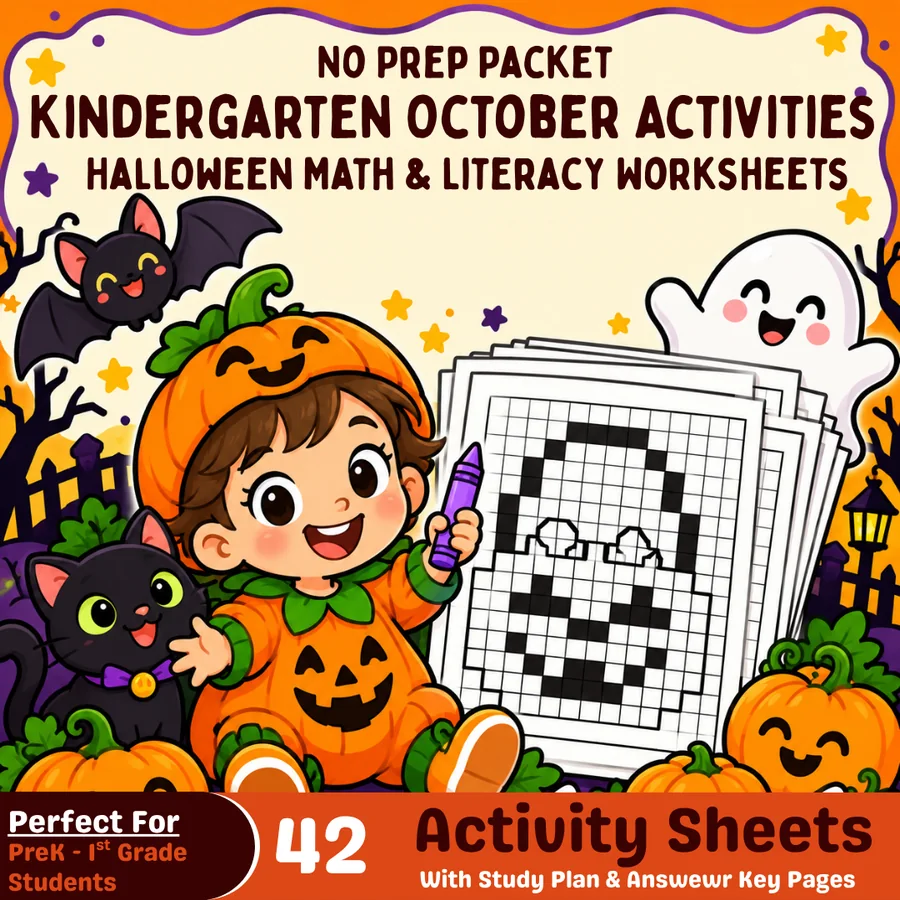
The 4th Grade Halloween Math Mystery Pictures includes eight original pictures (a spider, candy bucket, haunted house, scarecrow, lollipop, owl, cupcake and potion bottle), each tied to a fourth grade place value or computation skill, plus a 4-week study plan, a How to Use page, color answer keys and a Math Mystery Solver certificate.